Pilates for Back Pain and Scoliosis in Markham, Ontario
By Katherine, Lead Instructor, Certified Pilates Instructor
Align & Flow Pilates, at 7300 Warden Ave in Markham, teaches reformer and mat Pilates for scoliosis, desk posture, and neck and shoulder tension, and for back pain, including sciatica and disc issues, once cleared by a doctor or physiotherapist. Pilates may help you move with less pain but is not a cure or substitute for medical care, so we adapt sessions and work with your health care provider.

Key takeaways
Chronic low back pain: a Cochrane review found low-to-moderate quality evidence that Pilates reduces pain and disability versus minimal intervention, but not that it beats other exercise (Yamato et al., 2016).
Scoliosis: low-quality trials suggest possible short-term gains in pain and quality of life, but Pilates does not replace bracing, surgery or specialist care (Gou et al., 2021; OrthoInfo, AAOS).
Start with the Posture Assessment + 1:1 Pilates Intro (75 minutes, $110).
New difficulty urinating, loss of bladder or bowel control, saddle numbness, sciatica in both legs or rapidly worsening leg weakness need emergency care, not exercise.
Who do we work with at our Markham studio?
We work with clients who have scoliosis, adapting sessions after the posture assessment, and with clients who have back pain, including sciatica and disc issues, once their doctor or physiotherapist has cleared them. We also see people with desk posture, rounded shoulders, or neck and shoulder tension, and postnatal clients once their care provider has cleared them (see Pilates after giving birth).
We teach exercise; we do not diagnose or treat medical conditions, and our instructors are not physiotherapists. Our sessions are calm, intentional and mindful.
For desk posture, the evidence is limited: a 2024 review linked supervised Pilates programs to short-term improvements in specific postural measures in small trials, and almost none followed people after the program ended (Li et al., 2024), so any change is likely modest and depends on continued practice. See our neck and shoulder pain guide.
How does Pilates help with back pain?
A Cochrane review of 10 trials (510 people) found low-to-moderate quality evidence that Pilates reduces pain and disability in chronic low back pain compared with minimal intervention, but no conclusive evidence that it beats other exercise (Yamato et al., 2016). It is a reasonable option, not a proven cure, and the evidence does not cover new, acute pain.
Why it may help is less certain. Pain guidance on exercise for chronic low back pain describes graded exposure to avoided movements as a way to reduce fear and build confidence (Nijs, 2021), but it is not about Pilates, and the Cochrane trials did not test this mechanism; Pilates can be adjusted in range, springs and support at almost every step, so it may suit that approach. Check with your doctor or physiotherapist first, especially with sciatica, a disc issue or new pain. Our full evidence review on lower back pain goes deeper.
Can Pilates help scoliosis?
It may help with pain, trunk rotation and quality of life, but there is no good evidence that it can straighten a structural curve, and it does not replace medical care. A 2021 meta-analysis of 10 small trials (359 people, mostly adolescents) linked Pilates to less pain, less trunk rotation and better quality of life. The reviewers rated average trial quality only fair (5.3 out of 10) and urged caution (Gou et al., 2021). None of the included trials compared Pilates with bracing or surgery (Gou et al., 2021).
Bad posture does not cause scoliosis, and for growing children and teens with idiopathic scoliosis, bracing and surgery remain the only interventions shown to reliably change a curve's course (OrthoInfo, AAOS). Scoliosis-specific exercise such as the Schroth method is a distinct discipline that general Pilates does not replace (ScoliCare). We offer a complementary layer: general strength, postural awareness and breathing, adapted around your curve and coordinated with your care.
What happens at your first visit?
We recommend the Posture Assessment + 1:1 Pilates Intro, a 75-minute visit: a 15-minute posture assessment, then a 60-minute private intro. We ask about your health history, past injuries, and anything your doctor, physiotherapist or specialist has told you to avoid. The assessment is an observational look at how you stand and move, not a medical diagnosis. The intro uses exercises chosen around what we saw; with scoliosis, this is where we plan how to adapt sessions to your curve. See what a posture assessment involves.
How do we adapt reformer and mat Pilates to your back or curve?
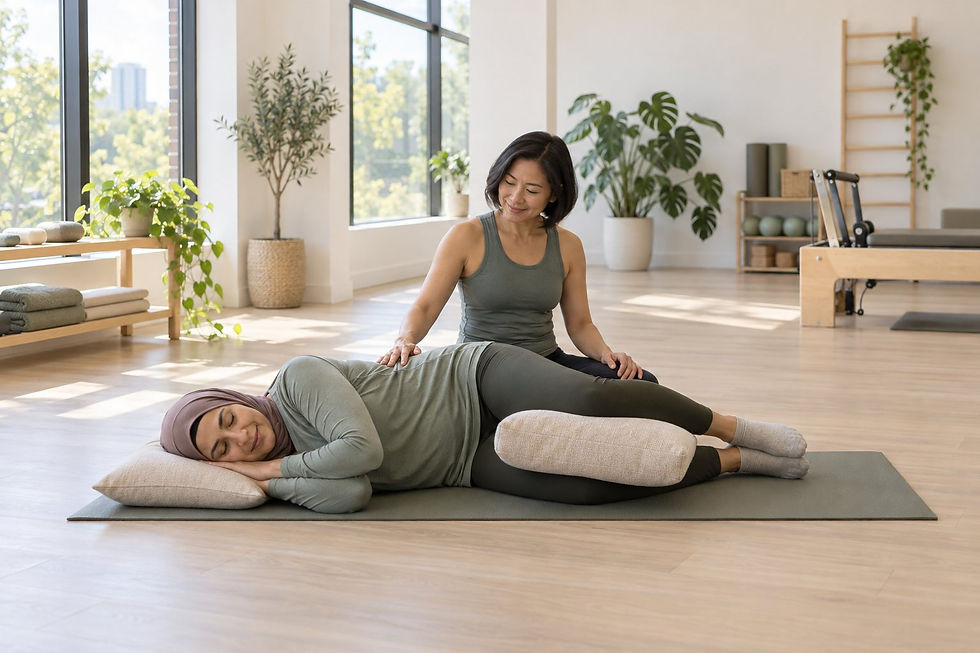
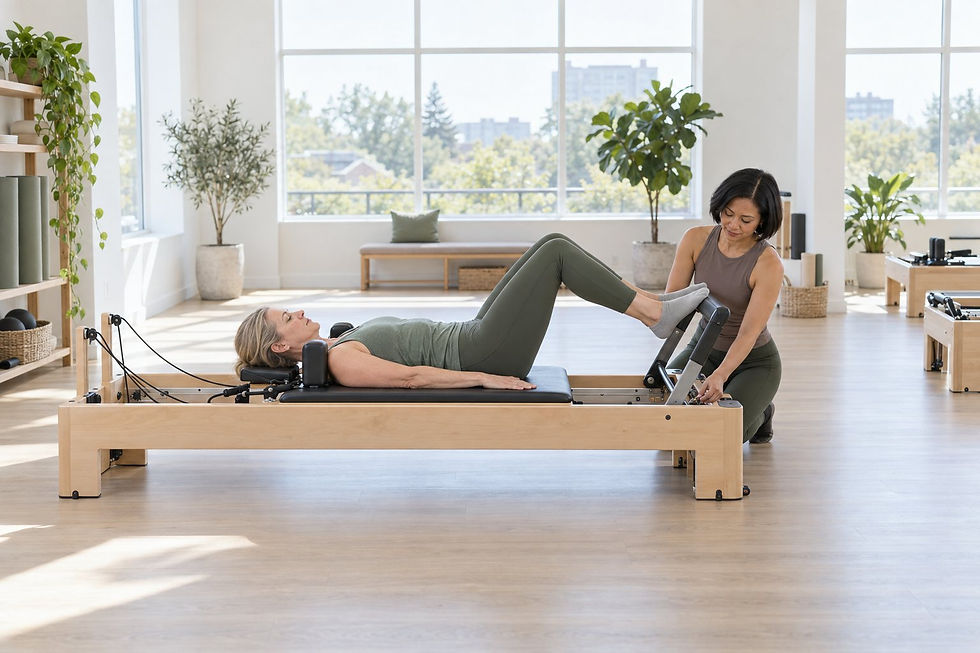
Both formats can be adapted, and no high-quality trial has directly compared reformer and mat Pilates for back pain, so the choice is individual. The reformer's springs can assist or resist a movement, making some exercises more supported; mat work relies more on body weight and control (reformer versus mat Pilates).
Sessions commonly start near a neutral spine with small, controlled ranges, guided by what your doctor or physiotherapist has advised and how you respond, and movements that combine deep forward rounding with load or rotation are often modified for back pain, disc issues and, depending on the curve, scoliosis. Sharp, pinching or radiating pain, including pain or tingling spreading down a leg, is a signal to stop and tell us.
How do we work alongside your doctor or physiotherapist?
See a physiotherapist or your family doctor first for a new injury or new or worsening pain, and get your surgeon's clearance after recent surgery. Physiotherapists are regulated health professionals who assess and plan care within a defined scope (College of Physiotherapists of Ontario); we teach exercise. Once you are cleared, Pilates can add strength and consistency, and many people do both at once.
If you have back pain, sciatica or a disc issue, we work with you once your doctor or physiotherapist has cleared you. If your curve is new, changing or monitored, check with your specialist first. See choosing between Pilates and physiotherapy.
When should you see a doctor before starting?
Get medical advice before Pilates, or stop and seek care, if you notice any of these:
New difficulty starting to urinate, loss of the urge to urinate, loss of bladder or bowel control, numbness in the saddle area (groin, genitals, buttocks or inner thighs), or sudden new sexual dysfunction with back or leg pain: go to an emergency department now, as these can signal cauda equina syndrome, a nerve emergency (AANS).
New or rapidly worsening leg weakness, or sciatica symptoms in both legs: go to an emergency department (AANS). New or worsening numbness or tingling in a leg: see a doctor the same day (Cleveland Clinic, 2024).
Fever, unexplained weight loss, a history of cancer, or back pain after major trauma.
Severe pain, pain that wakes you at night or is not easing with rest, or numbness, tingling or weakness in an arm or hand.
A spinal curve that is new, changing or monitored: check with your specialist first (OrthoInfo, AAOS).
Which session should you choose, and what does it cost?
If you have scoliosis, sciatica, a disc issue or active pain, we suggest starting with private 1:1 sessions so exercises can be adapted to you. Small group classes suit you once you are cleared and settled.
The Posture Assessment + 1:1 Pilates Intro, the recommended first visit, is $110 for 75 minutes. Private 1:1 sessions start from $75 per session with an Instructor and from $82 per session with our Lead Instructor, depending on the package. Private group sessions for 2 or 3 people start from $55 per person per session, and small group reformer classes (maximum 3) start from $39.90 per class with a 10-class pack.
New clients ready for group work can try 3 small group classes for $99 (new clients only, valid 30 days from purchase). See every pack on our pricing page.
Where can you find educational guides on Pilates for back pain and scoliosis?
Our Library is an educational resource on these topics. Each guide cites its sources and says what Pilates cannot do.
Where is the studio, and how small are the classes?
Align & Flow Pilates is a boutique, woman-owned studio at 7300 Warden Ave, Unit 118, Markham, ON L3R 9Z6, serving Markham, Unionville, Richmond Hill, York Region and the Greater Toronto Area. We see clients by appointment only: Mondays and Wednesdays 10 a.m. to 9 p.m.; Tuesdays, Thursdays, Fridays and Saturdays 10 a.m. to 7 p.m.; closed Sundays. Every group class has a maximum of 3 clients.
Safety note: This article is general information, not medical advice. If you have back pain, sciatica, a disc injury or scoliosis, check with your family doctor, physiotherapist or specialist before starting or changing an exercise program; after surgery, get your surgeon's clearance, and after giving birth, your obstetrician's, midwife's or family doctor's. Go to an emergency department for new difficulty urinating, loss of bladder or bowel control, saddle numbness, sciatica in both legs or rapidly worsening leg weakness. Stop a movement if you feel sharp, pinching or radiating pain. We do not diagnose or treat medical conditions.
Book your first visit at our Markham studio
Book the Posture Assessment + 1:1 Pilates Intro ($110, 75 minutes) and bring any guidance from your doctor, physiotherapist or specialist. You can book online or call 365-789-2838 with questions.
Frequently asked questions
Where can I do Pilates for scoliosis in Markham?
Align & Flow Pilates, at 7300 Warden Ave in Markham, works with clients who have scoliosis and adapts sessions after the posture assessment. We suggest starting with private 1:1 sessions and work alongside your doctor or specialist; Pilates does not replace bracing or specialist care. If your curve is new, changing, braced or monitored, check with your specialist before starting.
Is reformer Pilates good for back pain?
It can be, when adapted to you. No high-quality trial has directly compared reformer with mat Pilates for back pain, so neither is proven better. In a private session we can use reformer or mat work, whichever suits your back that day. Small group reformer classes (maximum 3) can follow once your instructor is confident your back tolerates them.
What should I look for in a Pilates studio for scoliosis or back pain in Ontario?
Look for a studio that takes a health history, adapts sessions to you, keeps groups small and works alongside your doctor or physiotherapist. Pilates does not diagnose, treat or cure a medical condition. Our group classes have a maximum of 3 clients. See how to choose a Pilates studio.
Should I start with a private session or a small group class?
With scoliosis, sciatica, a disc issue or active pain, we suggest starting privately, because a group class follows a shared sequence that cannot be adapted as closely. Once you are cleared, small group classes are a lower-cost way to continue (private versus group Pilates).
How much does a private Pilates session cost in Markham?
Private 1:1 sessions start from $75 per session with an Instructor and from $82 per session with our Lead Instructor on a 6-month membership, and the Posture Assessment + 1:1 Pilates Intro is $110; see our Markham Pilates price guide for every pack.
Sources
Yamato TP, Maher CG, Saragiotto BT, et al. (2016). Pilates for Low Back Pain: Complete Republication of a Cochrane Review. Spine, 41(12), 1013-1021. https://pubmed.ncbi.nlm.nih.gov/26679894/
Nijs J (2021). Exercise and Chronic Low Back Pain. IASP Fact Sheet. https://www.iasp-pain.org/resources/fact-sheets/exercise-and-chronic-low-back-pain/
Gou Y, Lei H, Zeng Y, et al. (2021). The effect of Pilates exercise training for scoliosis on improving spinal deformity and quality of life: Meta-analysis of randomized controlled trials. Medicine (Baltimore), 100(39), e27254. https://pubmed.ncbi.nlm.nih.gov/34596121/
OrthoInfo, American Academy of Orthopaedic Surgeons (n.d.). Scoliosis Overview. OrthoInfo. https://www.orthoinfo.org/en/diseases--conditions/introduction-to-scoliosis/
ScoliCare (n.d.). The Schroth Method: Scoliosis Management Techniques. ScoliCare. https://scolicare.com/schroth-method/
Li F, Omar Dev RD, Soh KG, et al. (2024). Effects of Pilates on Body Posture: A Systematic Review. Archives of Rehabilitation Research and Clinical Translation, 6(3), 100345. https://pubmed.ncbi.nlm.nih.gov/39372244/
American Association of Neurological Surgeons (2024). Cauda Equina Syndrome. https://www.aans.org/patients/conditions-treatments/cauda-equina-syndrome/
College of Physiotherapists of Ontario (2026). Titles, Credentials, and Specialty Designations Standard: Guide. https://collegept.org/standard/titles-credentials-and-specialty-designations-standard/guide/
Cleveland Clinic (2024). Herniated Disk (Bulging Disk): Symptoms & Treatment. Cleveland Clinic. https://my.clevelandclinic.org/health/diseases/12768-herniated-disk

Comments