Pilates for Hockey Players: Mobility, Core and Injury Resilience
Updated: Oct 6
By Katherine, Lead Instructor, Certified Pilates Instructor
Pilates may be a reasonable supplement for hockey players, mainly for hip mobility, trunk control and body awareness. We found no trial of Pilates in hockey players and no systematic review establishing that it improves athletic performance, so treat it as a complement to on-ice training and sport-specific strength work, not a replacement.

Key takeaways
Hockey puts the hips through forced, repetitive ranges of motion, and groin and hip problems are common (Kuhn et al., 2016).
In a 2026 cohort of high school and college players, tight hip flexors were linked to about three times the risk of time-loss low back pain, an association rather than proof that stretching prevents it (McHugh et al., 2026).
Evidence for Pilates in athletes is limited to small single-sport trials, and we located none in hockey (Yılmaz et al., 2025).
Plan Pilates around your season: more progressive in the off-season, shorter and lower-fatigue in-season.
Groin pain, hip pinching or back pain that lingers after games needs a proper assessment, not just more stretching.
What does hockey demand from your body?
Skating is typically done in a forward-leaning stance with the hips and knees bent. Strides, stops and cuts can load the hips and groin, and shooting, passing and turning add rotation through the trunk and pelvis (our general description of the sport, not a study finding). An orthopaedic review describes the sport as placing the hip in "forced and repetitive supraphysiological ranges of motion" and notes that players are commonly sidelined by groin injury or hip pain (Kuhn et al., 2016). Hip flexor tightness is also described as common in players because of the postural demands (McHugh et al., 2026).
For the wider picture of what Pilates can and cannot do for anyone, see our guide to the benefits of Pilates and what the research actually shows.
What does the evidence say about Pilates for hockey?
Honestly, very little. For athletes generally there are only small single-sport trials, and we located none in hockey. In a 2025 randomized trial of 30 amateur male soccer players, eight weeks of mat or reformer Pilates improved performance measures versus a control group, with reformer Pilates showing larger gains in agility, single-leg triple hop and passing accuracy. The sample was small and the sport was soccer, so it cannot tell us what would happen in hockey (Yılmaz et al., 2025).
We located no systematic review showing that Pilates improves athletic performance broadly, or does so better than standard strength and conditioning. Certainty is very low, so we see Pilates as a supplementary tool.
Which hockey risks have better evidence?
The stronger evidence is about the risks themselves, not about Pilates.
Off-season preparation. In a cohort of 1,292 NHL players, during training camp those reporting fewer than 18 off-season sport-specific sessions had 3.38 times the risk of a groin or abdominal strain, and a previous history of the same injury was linked to 2.88 times the risk. In-season training was a weaker risk factor, and peak adductor strength and hip abduction flexibility did not predict injury (Emery and Meeuwisse, 2001). It was observational, in elite men, and did not involve Pilates, but it suggests preparation matters.
Hip flexor tightness and back pain. Across 289 player-seasons in a boys' high school team and college men's and women's teams, 15.7% of players with tight hip flexors (measured with the Thomas test) developed time-loss low back pain, compared with 5.1% of players with normal flexibility. The authors recommend hip flexor stretching and postural training for tight players, but the study did not test an intervention. Hip flexion, abduction and adduction strength were not associated with low back pain (McHugh et al., 2026).
Groin pain prevention. A 2025 scoping review of 19 randomized trials found that the Copenhagen adduction exercise dominates the research (13 of 19 trials) and improves adductor strength, with reduced injuries in some trials, but that it shows limited preventive effects on its own. Abdominal, gluteus medius and trunk-hip coordination exercises were also used in some trials, and the authors describe newer coordination-based programs as showing emerging evidence. Pilates was not among the interventions the abstract identifies (Saito et al., 2025).
The practical reading is that sport-specific preparation, hip flexor flexibility and trunk control are plausible targets, and Pilates can train some of them. The cohort studies above did not find that hip strength predicted injury, so this is a reasonable fit, not proof.
What can Pilates add to a hockey player's week?
This is reasoned from how Pilates works, not from hockey trials.
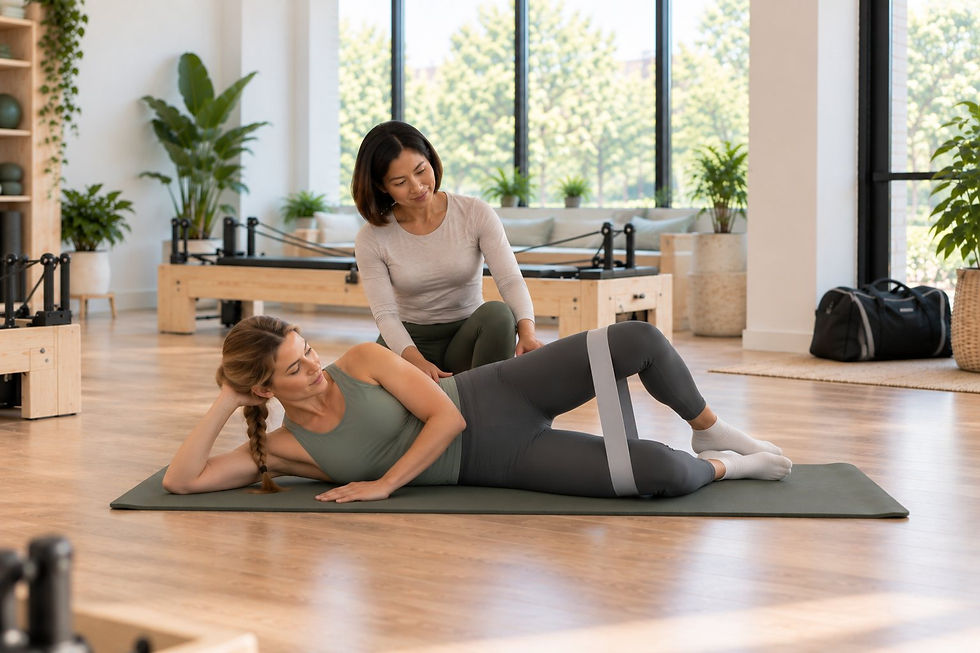
Hip mobility with control. Pilates moves the hip through range while the pelvis and spine stay steady. Our guide to whether Pilates improves flexibility covers the difference.
Trunk control for rotation. Rotating the ribcage over a stable pelvis, rather than twisting from the lower back, is a core Pilates skill. See what "engage your core" actually means.
Glutes, adductors and deep trunk muscles. Reformer springs let us load the hips and trunk gradually with close control of range. See our reformer vs mat comparison.
What Pilates does not replace is heavy lower-body strength work, power training, skating and conditioning. Our guide to Pilates vs strength training explains why many athletes use both, and Canadian guidelines recommend muscle-strengthening activities using major muscle groups at least twice a week for adults (CSEP).
How should Pilates fit your season?
No trial has compared Pilates schedules in hockey, so these are reasonable starting points we adjust to each player, not evidence-based prescriptions.
Off-season. One or two sessions a week alongside your strength and conditioning work lets us focus on hip range with control, single-leg stability, adductor and glute strength, and rotation.
In-season. Keep it short and low-fatigue. One session a week, placed away from game days and hard practices, may help maintain hip mobility and trunk control. If a session leaves your legs heavy, we reduce the load.
Coming back from a groin or back problem. Work with your physiotherapist or sports medicine doctor first. We adapt sessions around what they and you tell us. Our guide to Pilates or physiotherapy explains how the two fit together. For back pain, see Pilates for lower back pain.
Minor hockey families in Markham and York Region
If your child plays minor hockey, check with their doctor, physiotherapist or coach first, and contact us to ask whether sessions suit their age. Pilates is also not a substitute for the biggest injury levers in youth hockey. A 2025 narrative review identifies body checking as the most significant modifiable risk factor and reports that rules prohibiting it are linked to 50 to 70% lower injury rates and 57 to 60% fewer concussions (Zheng et al., 2025). For adults curious about the sport-specific side, see Pilates for men and Pilates for runners, another sport with repetitive lower-body loading.
When should you get assessed first?
This is general information, not medical advice. See your family doctor, physiotherapist or sports medicine physician before starting if you have groin pain lasting more than a few days, pinching in the hip, back pain spreading into the leg, numbness, a recent head injury or concussion, or pain that worsens after exercise. During a session, sharp pain, pinching or radiating symptoms are a signal to stop and tell your instructor. Mild muscular fatigue is normal.
Working on your hips and core with us in Markham
For a program built around your position, season and injury history, start one-on-one with Private 1:1 Pilates with Lead Instructor or Private 1:1 Pilates with Instructor (both 1 hr), or the Posture Assessment + 1:1 Pilates Intro (1 hr 15 min) if you want an alignment check first. A Small Group Pilates Class (reformer, maximum 3 people, 55 min) can suit you later, and our private vs group comparison can help you choose. You can book at our Markham studio here.
Frequently asked questions
Will Pilates make me a better skater?
We found no evidence that it will. No trial has tested Pilates on skating in hockey players, small trials in other sports report performance gains, and no systematic review shows Pilates improves athletic performance broadly. It may help your hips move and your trunk stay controlled, while skating and strength training still build skating ability.
Should I stretch my hip flexors if I play hockey?
A 2026 study of high school and college players found more time-loss back pain in players with tight hip flexors, and its authors recommend stretching and postural training for those players. It did not test stretching, so this is guidance rather than proof. A physiotherapist can measure your hip flexor length and tell you whether it applies to you.
Can Pilates help with groin pain?
Pilates can include adductor, glute and trunk work that overlaps with groin-pain prevention programs, but we did not find evidence that Pilates itself prevents or relieves groin pain. Pain that persists needs assessment by a physiotherapist or doctor first.
Sources
Kuhn AW, Noonan BC, Kelly BT, Larson CM, Bedi A (2016). The Hip in Ice Hockey: A Current Concepts Review. Arthroscopy, 32(9). PMID 27318779. https://doi.org/10.1016/j.arthro.2016.04.029
McHugh MP, Tyler TF, Schmitt BM, Kwiecien SY, Nicholas SJ (2026). The Association Between Hip Flexibility and Low Back Pain in Ice Hockey Players. Orthopaedic Journal of Sports Medicine, 14(2). https://doi.org/10.1177/23259671251404068
Emery CA, Meeuwisse WH (2001). Risk factors for groin injuries in hockey. Medicine and Science in Sports and Exercise, 33(9):1423-1433. https://pubmed.ncbi.nlm.nih.gov/11528328/
Saito H, Hakariya N, Ebato T, Hirose N (2025). A Scoping Review of Exercises for Preventing Athletic Groin Pain. Cureus. https://doi.org/10.7759/cureus.99883
Yılmaz O, Kaplan T, Batalik L (2025). Randomised Controlled Study on the Effects of Pilates Exercises in Soccer: Comparing Mat and Reformer Methods on Physical and Technical Performance. PLOS ONE, 20(5), e0324129. https://pmc.ncbi.nlm.nih.gov/articles/PMC12094727/
Zheng Y, Liu Y, Chen Y, Cao J, Chen E, Pan H, Huang P (2025). Research Progress on Common Sports Injuries Among Youth Ice Hockey Players and Prevention Strategies: A Narrative Review. Sports, 13(12), 449. https://doi.org/10.3390/sports13120449
Canadian Society for Exercise Physiology. Adults 18-64 Years, Canadian 24-Hour Movement Guidelines. https://csepguidelines.ca/adults-18-64/


Comments