Pilates vs Yoga: What's the Difference and Which Should You Choose?
Updated: Oct 6
By Katherine, Lead Instructor, Certified Pilates Instructor
Pilates and yoga are both mind-body exercise, but they have different aims. Pilates, which Joseph Pilates called "Contrology", trains controlled, precise movement and trunk strength, often with spring-loaded equipment. Yoga is an ancient practice rooted in Indian philosophy that combines postures, breathing techniques and meditation. For back pain, research does not show that either one is clearly better.

Key takeaways
Pilates is built around control, alignment and trunk strength, with breath timed to movement. Yoga combines postures, breathing practices and meditation, and its styles vary widely.
Pilates uses a mat or equipment such as the reformer; yoga is usually practised on a mat with simple props.
For chronic low back pain, a Cochrane review found low-to-moderate-quality evidence that Pilates reduces pain and disability more than minimal intervention, but not that it beats other exercise (Yamato et al., 2016). The yoga review found little or no difference in back-specific function versus back-focused exercise (Wieland et al., 2022).
"Which is harder" depends on the class, the instructor and you. Neither is automatically easier.
Doing both is a reasonable plan if you enjoy both, and choosing is mostly about your goals and what you will keep doing.
What is the difference between Pilates and yoga?
The short version is that Pilates is a strength-and-control method, and yoga is a broader practice that includes physical postures alongside breathing and meditation.
If you want the full background on the method itself, our guide to what Pilates is and how it works covers its principles. For a wider look at what Pilates has and has not been shown to do, see The Benefits of Pilates: What the Research Actually Shows.
Where did each one come from?
Pilates is a twentieth-century method. Joseph Pilates named his system "Contrology" and set out his ideas in books including Your Health (1934) and Return to Life Through Contrology (1945). He also designed equipment, most famously the Universal Reformer, along with pieces such as the Wunda Chair and the Ladder Barrel (Pilates Method Alliance).
Yoga is far older. The U.S. National Center for Complementary and Integrative Health describes it as an ancient and complex practice rooted in Indian philosophy, which as practised in the United States typically emphasizes physical postures, breathing techniques and meditation (NCCIH, 2023). In practice, yoga classes range from vigorous and athletic to slow and meditative, depending on the style and the teacher.
Pilates vs yoga: how they compare
Factor | Pilates | Yoga |
|---|---|---|
Origin | Early twentieth century, developed by Joseph Pilates | Ancient, rooted in Indian philosophy |
Main emphasis | Controlled, precise movement, alignment and trunk strength | Postures, breathing practices and meditation (varies by style) |
Breath | Coordinated with the phase of each movement | Often a practice in its own right, with specific breathing techniques |
Movement style | Short sets of controlled repetitions, with detailed cueing | Held postures and flowing sequences, depending on the style |
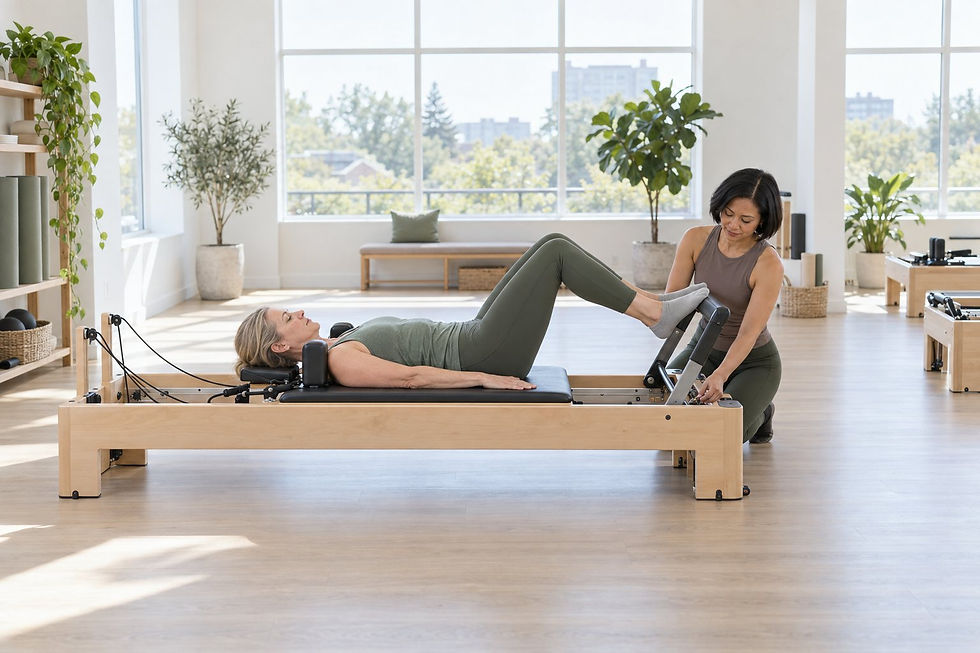
Equipment | Mat work, or spring-loaded equipment such as the reformer | Usually a mat, sometimes with props such as blocks and straps |
Typical class feel | Precise and focused, with frequent alignment cues | Ranges from athletic to restorative, depending on the style |
Treat this as a general guide rather than a rule: styles, studios and teachers differ a lot within both traditions.
How does the breathing differ?
In Pilates, breath is cued alongside movement, so you inhale and exhale at set points in an exercise to support control and trunk engagement. Many Pilates teachers also use a lateral (side and back rib) breathing pattern, which our guide to how to breathe in Pilates explains.

In yoga, breathing is usually taught as its own practice as well as something that accompanies postures, and classes may include dedicated breathing techniques and time for meditation.
Which is harder, Pilates or yoga?
There is no honest general answer, and we are not aware of research that ranks the two for difficulty. A reformer class with heavier springs can challenge your strength and control in a way that feels very different from a held balance posture in yoga, and the reverse is also true.
What people often find hard is the thing they are not used to. Someone who is naturally flexible may find precise trunk control in Pilates demanding, while someone who is strong but stiff may find yoga postures harder. Our Pilates for beginners guide explains what a first few classes are like, and a good instructor in either style should help you scale the work to your level.
What does the research say about flexibility and strength?
Both practices have some evidence behind them, with limits worth knowing about.
For yoga, a systematic review of 22 randomized trials in older adults (average age 60 or over) found that yoga improved lower-body flexibility, lower-limb strength and balance compared with inactive controls, and improved lower-body flexibility and lower-limb strength compared with active controls such as walking (Sivaramakrishnan et al., 2019).
For Pilates, a meta-analytical review of 51 trials in adults aged 55 and over found moderate effects on a combined physical outcome (strength, balance, endurance, flexibility, gait and physical functioning) versus inactive controls, and smaller effects versus active controls. Flexibility was pooled with the other outcomes, so it does not give a flexibility figure of its own, and the authors flagged substantial heterogeneity (Meikis et al., 2021). We cover this question in more depth in Does Pilates improve flexibility?
These reviews studied older adults, so they do not tell us how the two compare in younger adults, and neither review compared yoga and Pilates head to head. Both practices appear to build physical function; the evidence does not show that one builds more of it.
Which is better for back pain?
For chronic low back pain, the evidence is broadly similar for the two, and the rankings are not consistent. A Cochrane review of 10 trials found low-to-moderate quality evidence that Pilates reduces pain and disability compared with minimal intervention, and moderate-quality evidence of no significant difference in disability compared with other exercise. The authors concluded there is no conclusive evidence that Pilates is superior to other forms of exercise (Yamato et al., 2016).
The Cochrane review of yoga (21 trials, 2,223 people) found small, clinically unimportant improvements in pain and function versus no exercise at three months, and little or no difference in back-specific function compared with back-focused exercise. Adverse events, most often back pain, were more frequent with yoga than with no exercise, with little or no difference compared with other exercise (Wieland et al., 2022).
Network meta-analyses, which compare interventions indirectly, do not agree on a winner. One analysis of 36 trials ranked Pilates highest among four mind-body exercises for pain and function, while cautioning readers to view this carefully given the limited number of studies (Shi et al., 2022). Another, of 75 trials, found both reduced pain more than conventional rehabilitation, with yoga's numerical effect slightly larger, and its authors said a definitive recommendation was not yet possible (Li et al., 2023). Our guide to Pilates for lower back pain goes through what to do if your back is the main reason you are exercising. If your back pain is new, severe or comes with numbness, weakness, fever or bladder or bowel changes, see your doctor before starting either one. In our sessions we adapt exercises to you and work alongside your health care provider.
Which is better for weight loss?
Exercising one part of the body does not selectively reduce fat in that area, so neither practice can target fat in one place. A meta-analysis of 13 studies and 1,158 participants found essentially no effect of localized muscle training on fat in the trained area (Ramirez-Campillo et al., 2022). For the evidence on Pilates specifically, including who it was studied in and how modest the effects were, see Does Pilates Help You Lose Weight? The Honest Answer.
Canada's 24-Hour Movement Guidelines for adults recommend at least 150 minutes a week of moderate to vigorous aerobic activity and muscle strengthening at least twice a week. They do not name yoga or Pilates, so how a given class fits depends on how hard it makes you work (CSEP).
Can you do both?
Yes. We think there is a sensible case for it, though this is our judgment rather than a research finding, since we did not find trials that test the combination. Pilates tends to give structured strength and control work with clear cueing, and yoga can add held postures, breathing practices and meditation. If you enjoy both, they can sit comfortably in the same week.
A few practical tips if you try it:
Notice how your body feels the day after each session, and adjust the number of classes rather than pushing through.
Tell each instructor about the other practice and about any injuries or conditions.
Add aerobic activity such as walking, cycling or swimming as well, since many classes in either practice are not mainly aerobic.
How do you choose between Pilates and yoga?
Start with what you want from the class, then pick the one you will keep going to. Consistency matters more than the label.
Choose Pilates if you want guided, detailed cueing on alignment and trunk control, a structured way to add resistance (for example with the reformer), or a focus on posture and core.
Choose yoga if you want breathing practices and meditation to be part of your movement, or you enjoy held postures and flowing sequences.
Try both if you cannot decide. Many studios offer an introductory class, and a few sessions will tell you more than any comparison.
If you are comparing Pilates with another popular class, our guide to Pilates vs barre covers that choice. If you have a health condition, are pregnant or are older, check with your doctor or physiotherapist before starting either. The NCCIH notes that people in these groups should discuss yoga with their health care provider, and the same sensible step applies to Pilates (NCCIH, 2023). Stop and seek advice if you feel sharp, radiating or worsening pain.
Trying Pilates in Markham
If you are curious how Pilates feels compared with yoga, our Small Group Pilates Class is a good place to start: it is a reformer class limited to a maximum of 3 people, runs 55 minutes, and drop-ins are welcome. If you would prefer one-to-one attention first, our Posture Assessment + 1:1 Pilates Intro lets us learn about your goals and body before you join a class. Book a class at our Markham studio.
Frequently asked questions
Is Pilates or yoga better for beginners?
Neither is automatically easier. A beginner-level class in either one can be a good starting point if the instructor explains each movement and offers modifications. Choose the one you are more likely to attend regularly.
Can I do Pilates and yoga on the same day?
It can work, as long as the total load feels manageable. If you notice unusual soreness or pain, space the sessions out and talk to your instructors. See our guide to how often to do Pilates for planning a week.
Does yoga build core strength like Pilates?
Yoga postures involve the trunk muscles, but we are not aware of trials directly comparing core strength gains between yoga and Pilates. In Pilates, trunk control is the central focus, so it is cued and progressed more directly. In chronic low back pain, one systematic review found Pilates not inferior to matched-dose exercise for core muscle thickness (Franks et al., 2023).
Sources
Yamato TP, Maher CG, Saragiotto BT, Hancock MJ, Ostelo RWJG, Cabral CMN, Costa LCM, Costa LOP (2016). Pilates for Low Back Pain: Complete Republication of a Cochrane Review. Spine, 41(12), 1013-1021. https://pubmed.ncbi.nlm.nih.gov/26679894/
Wieland LS, Skoetz N, Pilkington K, Harbin S, Vempati R, Berman BM (2022). Yoga for chronic non-specific low back pain. Cochrane Database of Systematic Reviews, 2022;11:CD010671. https://www.cochrane.org/evidence/CD010671_yoga-chronic-non-specific-low-back-pain
Shi J, Hu ZY, Wen YR, et al. (2022). Optimal modes of mind-body exercise for treating chronic non-specific low back pain: Systematic review and network meta-analysis. Frontiers in Neuroscience, 16:1046518. https://pmc.ncbi.nlm.nih.gov/articles/PMC9713308/
Li Y, Yan L, Hou L, et al. (2023). Exercise intervention for patients with chronic low back pain: a systematic review and network meta-analysis. Frontiers in Public Health, 11:1155225. https://www.frontiersin.org/journals/public-health/articles/10.3389/fpubh.2023.1155225/full
Sivaramakrishnan D, Fitzsimons C, Kelly P, Ludwig K, Mutrie N, Saunders DH, Baker G (2019). The effects of yoga compared to active and inactive controls on physical function and health related quality of life in older adults: systematic review and meta-analysis of randomised controlled trials. International Journal of Behavioral Nutrition and Physical Activity, 16:33. https://doi.org/10.1186/s12966-019-0789-2
Meikis L, Wicker P, Donath L (2021). Effects of Pilates Training on Physiological and Psychological Health Parameters in Healthy Older Adults and in Older Adults With Clinical Conditions Over 55 Years: A Meta-Analytical Review. Frontiers in Neurology, 12:724218. https://pubmed.ncbi.nlm.nih.gov/34759879/
Franks J, Thwaites C, Morris ME (2023). Pilates to Improve Core Muscle Activation in Chronic Low Back Pain: A Systematic Review. Healthcare (Basel), 11(10), 1404. https://pubmed.ncbi.nlm.nih.gov/37239690/
Ramirez-Campillo R, Andrade DC, Clemente FM, Afonso J, Perez-Castilla A, Gentil P (2022). A proposed model to test the hypothesis of exercise-induced localized fat reduction (spot reduction), including a systematic review with meta-analysis. Human Movement, 23(3), 1-14. https://doi.org/10.5114/hm.2022.110373
National Center for Complementary and Integrative Health (2023). Yoga: Effectiveness and Safety. https://www.nccih.nih.gov/health/yoga-effectiveness-and-safety
Pilates Method Alliance. Pilates History. https://www.pilatesmethodalliance.org/pilates-history
Canadian Society for Exercise Physiology. Canadian 24-Hour Movement Guidelines for Adults 18-64 Years. https://csepguidelines.ca/adults-18-64/


Comments