What to Wear to Pilates (and Do You Really Need Grip Socks?)
Updated: Oct 6
By Katherine, Lead Instructor, Certified Pilates Instructor
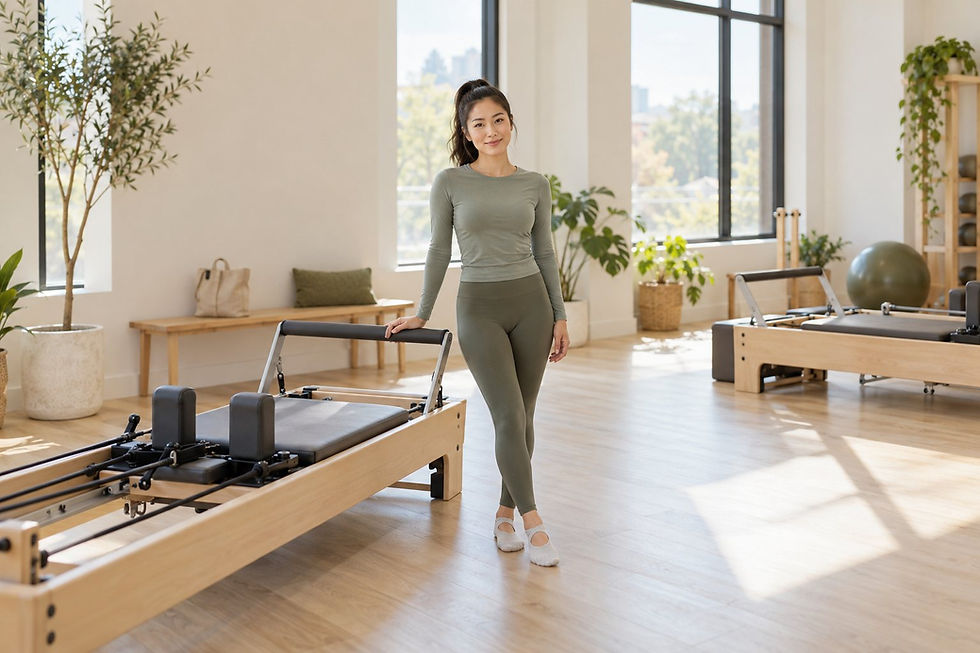
For Pilates, wear fitted, stretchy clothing you can move freely in, so your instructor can see your alignment, and skip zips, buckles and loose hems that can catch on equipment. On a reformer, many studios ask for grip socks instead of bare feet or regular socks, mainly for traction and hygiene. On the mat, bare feet are common, but policies vary, so check first.
Key takeaways
Choose close-fitting, stretchy clothes that stay put when you lie down, reach overhead and lift your legs. Your instructor needs to see how your ribs, spine, hips and knees line up.
Avoid zips, buckles, drawstrings, loose hems and dangling jewellery, which can catch on springs, straps and frames.
Grip socks are mainly a traction and hygiene convention, not a medical requirement. Regular socks can be slippery on a reformer, and policies on bare feet differ from studio to studio.
Mat classes are often done barefoot, though some people prefer grip socks there too for warmth or comfort.
In pregnancy and postpartum, comfort, breathability and an easy waistband matter more than any particular brand or style.
Why does fitted clothing matter in Pilates?
Pilates is built on precise positioning, and your instructor cues you by watching how your body moves (our complete guide to Pilates explains the method). Baggy tops and wide-legged pants can hide your shoulder position, the curve of your spine, or how your knees track over your toes, which makes accurate feedback harder.
Fitted does not mean tight. The test is simple: can you roll down through your spine, reach overhead and lift your legs without tugging at your clothes? If yes, it works.
What should you wear on top and on the bottom?
Tops. A fitted tank, T-shirt or long-sleeved top that stays in place when you lie back and raise your arms is ideal. Very loose tops tend to ride up or fall toward your face when you lie down or lift your hips. A supportive sports bra that is comfortable lying flat, without hard hooks or thick straps pressing into your back, makes mat and reformer work easier.
Bottoms. Full-length or capri leggings are the most reliable choice, especially for reformer work where your legs may be in straps. Shorts can work, but very short or wide-legged styles can ride up when your legs are lifted. Choose a waistband that stays flat and does not roll down when you lie on your back.
What to avoid:
Zips, buckles, metal snaps and exposed rivets, which can scratch equipment or press into you on the mat or carriage
Drawstrings and loose hems that can hook on a spring, strap or footbar
Very slippery fabrics, which can make you slide on a padded surface
Do you really need grip socks for Pilates?
For reformer classes, at many studios the honest answer is yes, or at least a sock with some traction. Grip socks have small rubberized dots or pads on the sole, so your feet stay steady on the footbar and carriage while the springs are working. They are a convention of the studio format rather than a health requirement, and we are not aware of any health guideline that mandates them.

For our Small Group Pilates Class on the reformer, bring grip or closed-toe socks. Our guide to reformer Pilates explains how the carriage, springs and footbar work.
Why do reformer studios require them?
There are two practical reasons:
Traction. A bare foot on a smooth footbar, or a regular cotton sock on a smooth carriage, can slide at exactly the moment you are pushing against spring resistance. Grip soles reduce that risk.
Hygiene. Many people touch the same shared surfaces, and some prefer a layer of fabric between their skin and the floor or equipment. The NHS notes that athlete's foot, a common fungal skin infection, can be picked up by walking barefoot where someone else has it, especially in changing rooms and showers (NHS, athlete's foot). That source covers communal wet areas, not Pilates studios, and we found no research on infection risk in Pilates studios, so treat socks as a personal preference rather than a guarantee.
Can regular socks work?
Sometimes, but not reliably. Ordinary socks have no traction, and on a smooth footbar or carriage they can slip. If you forget your grip socks, ask the studio before class rather than trying to get by with slippery ones. Barefoot on the reformer is allowed at some studios and not at others, so check the studio's policy when you book.
Is it better to go barefoot on the mat?
On the mat, barefoot is common and often preferred. It lets you feel the floor, spread your toes and notice how your weight is distributed. Grip socks are a reasonable alternative if your feet get cold, if you prefer a layer between you and a shared floor, or if the studio asks for them.
What about hair, jewellery and layers?
Hair: Tie long hair back so it is not caught under your shoulders or in your face when you lie down or roll over.
Jewellery: Take off long necklaces, dangling earrings, bracelets and large rings. Chains and straps can tangle with springs, and rings can scratch a frame. Small stud earrings are usually fine.
Layers: Start with a light layer, such as a thin zip-free pullover or wrap, for the warm-up, and take it off once you are warm. Avoid thick layers that hide your shoulders and ribs.
What should you wear when pregnant or postpartum?
During pregnancy, comfort and temperature control are the priorities. NHS guidance on exercising in pregnancy advises keeping cool by wearing the right clothing and staying hydrated (NHS, exercise in pregnancy). Beyond that general advice, practical choices include breathable, stretchy fabrics, a supportive bra and a waistband or panel that does not press on your belly, and layers are easy to shed as you warm up. Whether and how to exercise is a decision to make with your prenatal care provider, as we explain in our guide to Pilates during pregnancy.
After birth, the same principles apply. A soft, stretchy waistband that sits comfortably, and a nursing-friendly or easy-access top if you are breastfeeding, make sessions more comfortable. If you have had a C-section, choose a waistband that feels comfortable around your scar. For timing, see our guide to starting Pilates after giving birth.
Getting ready for a class with us in Markham
If you are unsure about clothing or socks, ask us before you come in. Clothing is only part of being ready, so our guide to what to expect at your first Pilates class covers the rest. If you are ready to try a reformer class, our Small Group Pilates Class (reformer, a maximum of 3 people, 55 min, drop-ins welcome) is a good place to start at our Markham studio. You can book it from our classes page.
Frequently asked questions
Can I wear leggings with a pattern or a sheer fabric?
Yes, as long as the fabric stays opaque when you stretch and you feel comfortable in it.
Should I wear shoes in a Pilates class?
Not usually. Pilates is generally done barefoot or in grip socks, so you can feel the floor or footbar and move your feet freely. If you have a reason to wear supportive footwear, such as a foot or ankle condition, mention it to your instructor before class.
Do I need to buy special Pilates clothes?
No. Any comfortable, fitted workout clothes you already own will do, provided they stay put and have no zips or buckles. Grip socks are the one item reformer studios commonly ask you to bring.
Does what I wear change for a posture assessment?
Fitted, comfortable clothing matters even more, because the instructor looks at how you stand and move. Our guide to posture assessments explains what happens. If you are unsure what to wear for your Posture Assessment + 1:1 Pilates Intro, ask us before you come in.
Sources
National Health Service (NHS) (n.d.). Athlete's foot. NHS.uk, accessed October 2026. https://www.nhs.uk/conditions/athletes-foot/
National Health Service (NHS) (n.d.). Exercise in pregnancy. NHS.uk, accessed October 2026. https://www.nhs.uk/pregnancy/keeping-well/exercise/


Comments